Step Into My Sessions: Looking Back to See New Choices
When we map a moment, new choices become visible.
Often, when students struggle in a social moment, it isn’t that they don’t care or don’t want to do the right thing—it’s that the situation moved too quickly for them to fully understand what was happening. Life can move so quickly! After such moments, looking back together can be incredibly helpful. 😊
This week I’ll show you how I created a visual support with a student to slow down a social situation and map out 🗺️ what actually happened, what each person might have been thinking, and where different choices could have been made. The goal wasn’t to point out mistakes. It was to make the moment visible enough that new options could finally come into focus. 🖼️🔍
Here’s the sequence I went through with a high school student. It’s his second year at a high school for students with learning differences, and he’s still finding his way, especially when he sees a “job” he’d like to do!
Step 1: Slowing the moment down
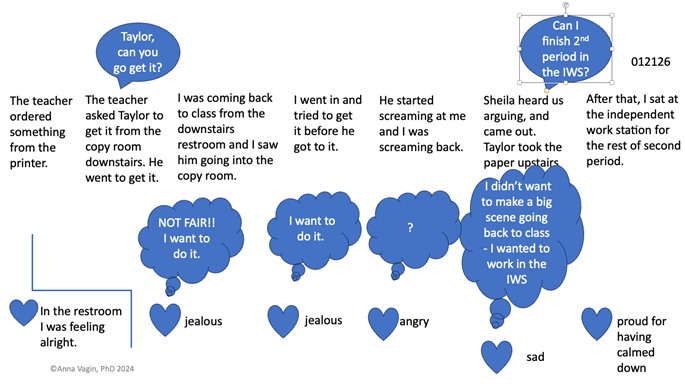
First, we wrote out the basic sequence of what happened. We added thought bubbles and feeling words so we could make the invisible parts of the situation visible. 💬 So important that students can see how a situation unfolded, and keep all the complex information in working memory while we discussed. 🧠💡
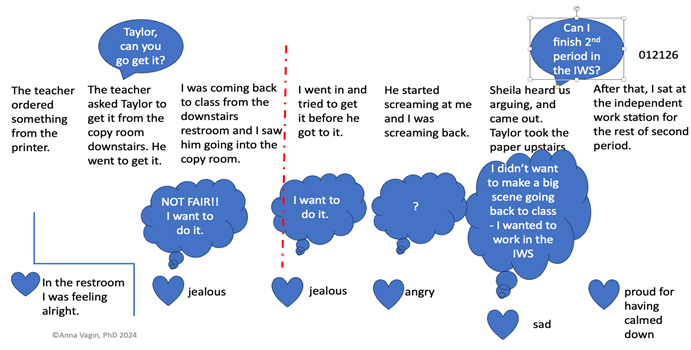
Step 2: Finding the “choice point”
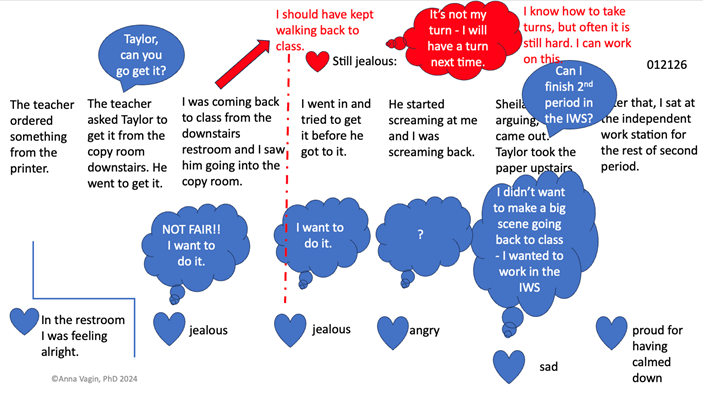
Finally, we mapped out an alternate choice the student could have made in that moment.
The most important insight came next: even with the different/better choice, he realized he still would have felt upset and jealous. 😔
That mattered a lot.
At first, he assumed that if he’d handled the situation differently, he would have felt fine. But, so often, better choices don’t make the feelings disappear. 💙 They can prevent a situation from getting bigger, but the feelings are still there – in fact, they can get bigger due to the frustration of NOT having ACTED as they might have wanted.
One example like this is clearly insufficient to result in change. Students need many opportunities to revisit these ideas, using real situations as well as animations where the stakes don’t feel so personal. 💡🎞️
Each time we slow a moment down, map out what happened, and consider alternate choices, we’re helping our students build a deeper understanding of something fundamental about emotional life: doing the right thing doesn’t always make the uncomfortable feelings disappear.
In fact, those feelings are often the hardest part of making a better choice. The more chances students have to see this pattern, the more prepared they become to navigate those moments when they arise again.
Reflective moment
How do you support your students in understanding that good choices can still lead to uncomfortable feelings?
Hope you are enjoying the longer evenings – I know I am! 🌇