Step Into My Sessions: Not Everyone Is Your Person: Navigating Relationships That Are Hard
It's okay to not like everyone. What matters is what we do next.
In our sessions, we often talk about friendship: how to build it, how to maintain it, and how to navigate when things go wrong.
But there’s another side to this conversation that doesn’t always get as much attention: what happens when you simply (or really) don’t like someone? Or when someone doesn’t treat you very well?
These are real experiences for our students, and they deserve space to be talked about honestly.
Navigating Difficult Relationships
✨ It's important for our groups to be a place where students share their truth, hear that they’re not alone, and begin to think through what their options might be.
It’s not a simple process. It involves perspective taking, managing strong feelings, and sometimes even extending a bit of grace. But it’s an important part of helping students understand relationships in a more complete and realistic way.
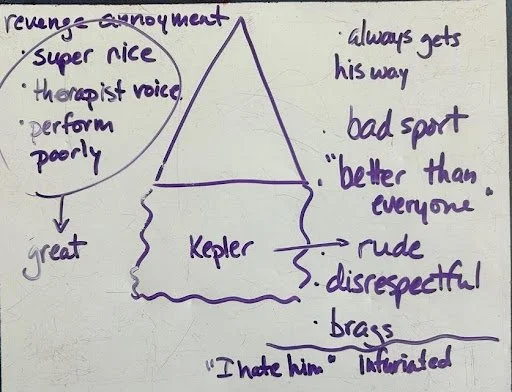
Let’s take a deeper look at the illustration above. 🔍
This student in group talked about Kepler, who he described in very negative terms. "I hate him." 😡 He talked about how Kepler infuriates him - what a great emotional description!
🫢 He also described how he engages in "revenge annoyment" to get back at Kepler. He is super nice to him, uses a "therapist voice" when he talks to him, and will perform poorly if he is on a team or group project with Kepler, just to make him mad.
Interestingly, the group supported what my student does, in fact, maybe got some ideas of what they could do with those students who annoyed them. The "therapist voice" in particular was seen as an effective revenge strategy. 🫣
"Revenge Annoyment" - Choosing how to Respond
At the same time, this opened up an important conversation. While everyone could appreciate the creativity and control behind these strategies, we began to think together about what they might lead to over time. 🤔🕰️
Does “revenge annoyment” actually make things better? Or does it keep the focus on the other person, keeping those feelings active and close to the surface? 👉 We talked about how these responses, while clever, don’t always move the situation in a direction that feels better in the long run.
This is where the work becomes more nuanced.
💡 It’s not about shutting down what students are sharing. They are telling us something real. It’s about helping them hold onto that truth (“He infuriates me”) while also considering other options.
🔷 What might it look like to create a bit more distance?
🔷 To stay neutral without engaging?
🔷 To choose when to invest energy and when to step back?
These are not easy shifts. They require perspective-taking, regulation, and a growing awareness of what actually helps. But starting from a place where students feel heard—even when their ideas are imperfect—is what allows that next layer of thinking to emerge.
🪞 Reflective moment
When students share strategies that feel effective to them—but may not lead to better outcomes—how do you respond in a way that keeps them feeling heard while opening the door to new thinking?